According to researchers, the prominent presence of heavy minerals in Nijhum Dwip's sands indicates fresh possibilities for Bangladesh's mineral resource exploration and industrial production. These minerals hold considerable economic value as raw materials for various sectors, including ceramics, paints, metal processing, and welding rod manufacturing.
Understanding the characteristics of this mineral-rich sand involves examining the geological history of sediment transport via the Ganges-Brahmaputra-Meghna (GBM) river system. Originating in the Himalayas, the Ganges and Brahmaputra rivers transport vast volumes of sediment into Bangladesh, eventually discharging into the Bay of Bengal through the Meghna estuary. Over long distances across river channels, estuaries, deltas, and seabed environments, these sediments are transported, sorted, and redistributed. A portion of this sediment settles along coastal zones, forming layers rich in heavy minerals.
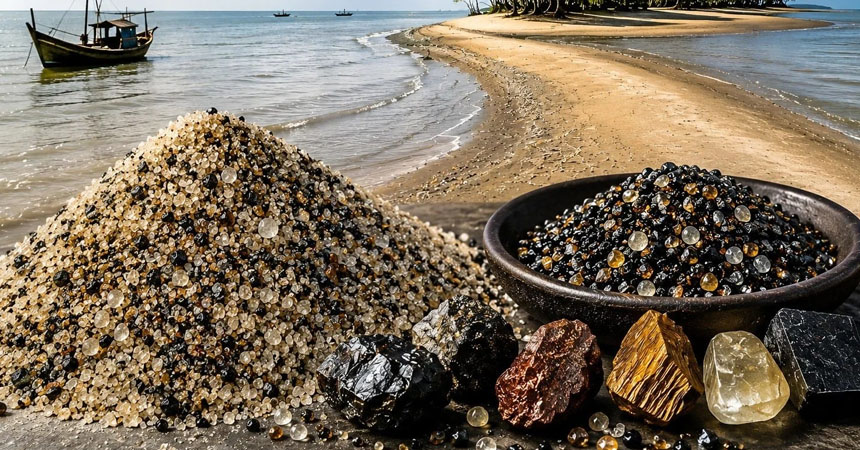
Analysis of Nijhum Dwip's beach sand identified heavy minerals making up nearly a quarter of the total sediment. Identified high-value minerals include sillimanite, garnet (almandine), zircon, rutile, ilmenite, xenotime, monazite, and kyanite. Additionally, various minerals from the amphibole and pyroxene groups were detected.
The study also identified multiple minerals in the magnetic fraction of the sand, with enstatite present in notable quantities. Other identified minerals include biotite, pargasite, muscovite, sodalite, diopside, magnesite, spinel, tremolite, anorthite, magnesioferrite, titanite, periclase, spodumene, and hornblende.
These findings suggest that the island's beach sand possesses potential beyond ordinary construction use, containing a diverse assembly of high-value industrial minerals.
Because multiple minerals occur alongside one another and share similar physical characteristics, separating and identifying them through conventional methods presents challenges. To overcome this, advanced X-ray Diffraction (XRD) technology was employed.
Sand samples were analyzed using a Japanese-made 'SmartLab SE (Rigaku)' X-ray diffractometer. Subsequently, mineral identification was conducted using the auto-matching method of the 'X'Pert HighScore Plus' software for digital data analysis, enabling precise profiling of the minerals present in the samples. Researchers noted that technology-driven analysis provides more accurate data for evaluating economically significant minerals in coastal sands.
Efforts have also been made to assess the potential of sand from Bangladesh's rivers as raw material for modern industries, particularly the semiconductor sector. Surveys spanning approximately 5,481 square kilometers across eight major river systems collected more than 6,600 samples.
Out of these, petro-mineralogical, chemical, and physical analyses have been completed for over 800 samples. This large-scale sampling research aims to yield detailed insights into the nature, sources, and industrial applications of minerals present in Bangladesh's river and coastal sediments. Researchers emphasize that riverborne sediment represents not just land-building material, but a prospective source of industrial raw materials.
Several minerals identified in Nijhum Dwip’s sand hold international industrial importance, notably zircon, rutile, and ilmenite. Zircon is widely utilized in manufacturing and serves as a key mineral in geological research. Rutile and ilmenite are titanium-bearing minerals providing foundational materials for titanium-based industries, with applications across paint, ceramic, and metallurgical processing.
Garnet, sillimanite, and kyanite also hold industrial utility. Due to their high thermal resistance, sillimanite and kyanite are candidate materials for refractory industries, while garnet is used as an industrial abrasive. Meanwhile, monazite and xenotime carry economic significance as potential sources of rare earth elements (REEs) and other high-value compounds.
From a broader geological perspective, these mineral-rich deposits in the Bay of Bengal are part of a larger regional phenomenon. The Ganges and Brahmaputra rivers collect immense quantities of rock and mineral particles from the Himalayas and surrounding geological formations, transporting hundreds of millions of tons of sediment to the Bay of Bengal annually. The river sediments first deposit in deltaic and estuarine regions before being resorted and redistributed by tidal action, wave energy, cyclones, and seabed currents.
This natural sorting process allows denser mineral particles to concentrate in specific environments, resulting in coastal heavy mineral concentrations significantly higher than those found in typical river sand. Studies indicate that Brahmaputra sediments exert a dominant influence on the Bengal shelf and deep-sea sediments, contributing at least two-thirds of the sand fractions, whereas the Ganges contributes substantially to finer silt and clay fractions.
While a 25 percent heavy mineral concentration in Nijhum Dwip's sand demonstrates strong potential, researchers caution that high mineral density alone does not constitute a commercially viable deposit.
Prior to commercial extraction, detailed assessments are required to determine the actual reserve volume, depth, spatial extent, individual mineral concentrations, feasibility of extraction, processing costs, and environmental impacts. Given that Nijhum Dwip is an ecologically sensitive coastal island, potential impacts on local beaches and biodiversity must be evaluated.
Nevertheless, these preliminary research findings present new prospects for Bangladesh. Confirming substantial reserves of valuable heavy minerals could help reduce local industry dependence on imported raw materials, while opening potential avenues for processing and exporting select minerals in the future.
Researchers advocate for expanded, systematic surveys of mineral-rich coastal sands across regions like Nijhum Dwip. Integrating the mineral resources of the country's major rivers and deltaic sediments into a comprehensive geological survey could provide a broader picture of Bangladesh's undiscovered industrial mineral wealth.