
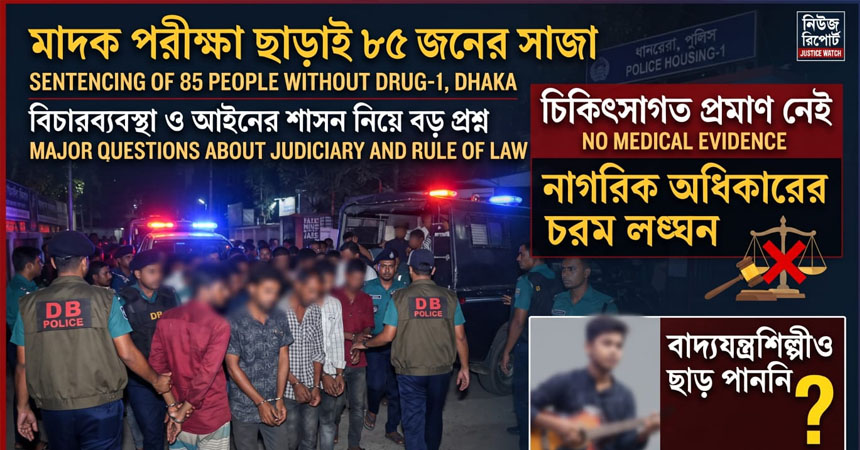
In a democratic state, such an incident represents a clear violation of constitutional fundamental rights and the principles of natural justice. Article 31 of the Constitution of the People's Republic of Bangladesh guarantees the right to protection of law, stipulating that no action detrimental to the life, liberty, body, reputation, or property of any person shall be taken except in accordance with law. A cornerstone of any judicial process is the presumption of innocence until proven guilty. Handing down mass sentences to 85 people without any scientific or medical evidence—such as urine or blood tests—directly contradicts this fundamental legal tenet.
While the Mobile Court Act of 2009 permits immediate summary trials, establishing specific offenses requires objective and irrefutable evidence. Under narcotics control laws, confirming drug consumption typically mandates laboratory sample testing or a physician's certificate. Legally, proving a specific charge like drug use without medical verification is virtually impossible.
This incident exposes deeply troubling dimensions. Mere presence at a social gathering, event, or private residence does not render an individual a criminal. Even if illicit activities or drug use occurred on the premises, sentencing everyone present without individually verifying their involvement demonstrates a severe lack of judicial prudence. Furthermore, the victimized young man is a professional musician whose career requires attendance at various entertainment gatherings. Arbitrarily arresting and penalizing such professionals without due investigation poses a grave threat to cultural practice and occupational security.
Given that the raided property belongs to a senior police official, it is imperative to impartially examine whether there was any abuse of power, bias, or unwarranted use of force against ordinary citizens. To safeguard human rights and the rule of law, a transparent and independent judicial inquiry committee must be formed to investigate the entire process that led to the mass sentencing of 85 individuals without empirical proof.
Legal protocols must make medical or chemical testing mandatory in narcotics cases under mobile courts or any summary legal proceedings, as penalizing citizens based merely on assumption undermines the rule of law. For cases marked by procedural lapses and evidentiary deficits, higher courts should review the verdicts to ensure the swift release and legal remedy of innocent victims. Simultaneously, strict oversight and institutional accountability are essential to prevent law enforcement agencies from abusing authority and harassing ordinary citizens.
At a time when the nation aspires to strengthen democratic values and civic rights, such incidents breed widespread public apprehension. The primary duty of the state and the judiciary is to protect the innocent while bringing actual offenders to justice. Without transparency, impartiality, and science-based evidence in the judicial process, public confidence in the legal system risks severe erosion. A thorough and transparent investigation into this incident to uncover the truth and ensure justice for the affected is an urgent imperative of the time.