For many indigenous families, shifting cultivation, locally known as jum farming, remains the main source of income. But as earnings depend heavily on nature and market conditions, maintaining household expenses year-round is often difficult.
The burden is particularly felt by women and students. With limited family income spent on food, healthcare and education, many have little opportunity to earn independently. Yet many of them are eager to learn skills and dream of contributing to their families.
An initiative by Bashundhara Shuvo Sangho is helping turn some of those dreams into reality.
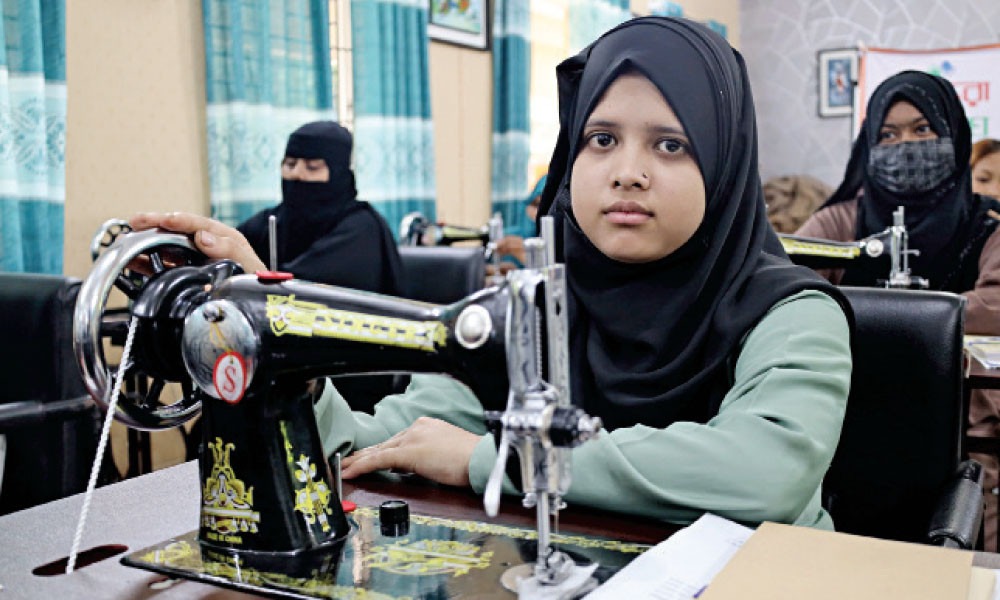
Under the initiative, 40 financially disadvantaged women from Alikadam and Bandarban Sadar upazilas received three months of free sewing training. Upon completion of the training, each participant was given a sewing machine, creating an opportunity for them to use their newly acquired skills to earn an income.
The sewing machines were handed over recently at separate programmes held at the upazila parishad halls of Alikadam and Bandarban Sadar.
Among those present were Alikadam Upazila Agriculture Officer Md Sohel Rana, Bandarban Sadar Police Station Officer-in-Charge Md Shahed Parvez, Bandarban District Press Club President Aminul Haque Bacchu, Bashundhara Shuvo Sangho Director Zakaria Zaman, and representatives of the local administration, media and social organisations.
Chammum wants to become self-reliant while studying
For Chammum Mro of Maranpara in Alikadam, life has been shaped by financial hardship. One of three brothers and eight sisters, she is currently a Class XII student at Alikadam College.
Her father, Rengkai Mro, works in shifting cultivation and supports the large family with his limited income.
Growing up in a large family, Chammum has witnessed financial difficulties from an early age. Although she wanted to continue her education and become self-reliant, her family's limited resources meant she had to depend on them even for her personal expenses.
The sewing training gave her an opportunity to learn a practical skill. She also received a sewing machine from Bashundhara Group.
Chammum said her father's income from jum cultivation is not enough to meet all the needs of such a large family. She now hopes to sew clothes alongside her studies, cover some of her own expenses and contribute to her family.
To her, the sewing machine is more than just a piece of equipment—it is an opportunity to build her future.
Laizu plans to ease her family's financial burden
Laizu Akter, a Class XII student at Lama College from Nayapara village in Alikadam, has also faced financial hardship.
Her father became paralysed after suffering a stroke around 13 years ago, bringing the family's financial situation under severe strain. With his regular income gone, her elder sisters had to shoulder much of the family's responsibilities.
With their support, Laizu has continued her education. She already gives private tuition to cover some of her personal expenses and does not want to remain entirely dependent on her family.
After receiving three months of sewing training and a sewing machine, she now plans to combine sewing with tutoring to earn more.
Laizu believes that even a small personal income could help reduce the financial pressure on her family while allowing her to continue her studies and work towards becoming self-reliant.
Masingching dreams of supporting her family
Masingching Marma of Rening Para in Bandarban Sadar is another beneficiary of the initiative.
A Class X student at Lotus Shishu Sadan Residential High School, she is the daughter of Thoaichingnu Marma, who works as an office assistant at a primary school.
With limited family income and the educational expenses of two daughters, Masingching wanted to acquire a practical skill alongside her studies.
After completing the sewing training, she now has a sewing machine of her own. She hopes to use it to earn in the future, help meet her educational expenses and support her family.
Mesaingnu continues her struggle after losing her mother
Mesaingnu Marma, a fourth-year honours student in the History Department at Bandarban Government College, has also faced a difficult journey.
Her mother died years ago, while her father, Sabai U Marma, supports the family through farming.
With the family dependent on his limited income, Mesaingnu has been thinking about ways to contribute financially while continuing her education.
The sewing training and machine have given her an opportunity to turn that intention into action. She hopes to earn through sewing and reduce some of the financial pressure on her father.
Shyamoli hopes to contribute to her family
Shyamoli Tanchangya, a second-year undergraduate student at Bandarban Government College, is another beneficiary.
Her father, Kadam Tanchangya, has a limited income, while the family also relies on the earnings of her brother, who works for an NGO.
Despite the financial challenges, Shyamoli continues her studies and hopes to share her family's responsibilities through her own earnings in the future.
She believes the sewing training and machine have opened a possible path towards achieving that goal.
Training combined with equipment creates an opportunity
Those involved in the initiative say simply distributing sewing machines may not always ensure that beneficiaries can use them effectively in the long term. That is why the women were given three months of training before receiving the machines.
The training provided them with basic sewing skills as well as practical experience in operating the machines.
According to the organisers, women in low-income families often lack opportunities for self-employment because of limited employment options and household responsibilities. Providing them with practical skills and the necessary equipment can make it easier for them to create their own sources of income.
Alikadam Upazila Agriculture Officer Md Sohel Rana praised the initiative, saying sewing training and machines could create self-employment opportunities for women in marginalised areas and help them become economically empowered.
Bandarban Sadar Police Station OC Md Shahed Parvez also praised the initiative, saying free training and sewing machines could help women in remote areas become more self-reliant.
Bandarban District Press Club President Aminul Haque Bacchu said the three-month free training before distributing the machines was particularly important, as it enabled beneficiaries to develop the skills needed to use the equipment effectively.
Bashundhara Shuvo Sangho Bandarban District Branch President Uyai Sing Marma said many women in the hill tracts face various barriers to employment. Equipping them with practical skills could bring positive changes to their families and communities.
One machine, a new possibility for a family
A significant number of the 40 beneficiaries are from indigenous communities, including school, college and university students. Their family circumstances vary—some depend on jum cultivation, some on farming, while others struggle with illness or limited household income.
Their stories are different, but their aspirations are largely the same: to continue their education, meet some of their own expenses and, when possible, support their families.
Local residents believe sewing machines can become an important tool in turning those aspirations into reality. Employment opportunities for women remain limited in many remote hill areas, they said, and sustained initiatives of this kind could not only improve the financial condition of individual families but also strengthen a culture of self-reliance among women.
For Chammum, Laizu, Masingching, Mesaingnu and Shyamoli, the sewing machines are more than gifts. For some, they represent a means to continue their education; for others, an opportunity to support their families or make an independent start in life.
In the challenging realities of the hill tracts, placing a sewing machine in the hands of these 40 women has therefore opened a door to new possibilities.
How far they can go by turning their skills into sustainable income remains to be seen. But for these women, the journey towards self-reliance has already begun.