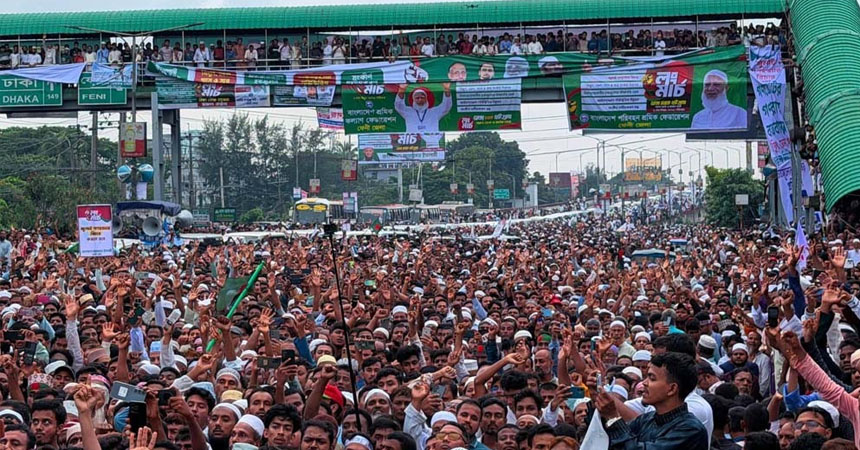
Against this backdrop, setting a deadline for the fall of a government that has received a popular mandate runs contrary to democratic norms. Yet, the recent programme organised by an 11-party alliance on the Dhaka-Chattogram highway was more than an ordinary opposition protest. The massive mobilisation and the statements delivered from the platform have raised new questions about the future direction of Bangladesh's politics.
At Mohipal in Feni, Jamaat-e-Islami Ameer and opposition leader Dr Shafiqur Rahman spoke of the “footsteps of fascism”, while Liberal Democratic Party (LDP) Chairman Col (retd) Oli Ahmed went a step further by setting December as a deadline for bringing down the government. He also called on alliance activists and supporters to prepare themselves for assuming power.
In a democratic system, governments generally change through elections, the loss of a parliamentary majority, or the expiry of a constitutional term. Declaring a particular month as the “month of government change” from a political rally, therefore, does not fit comfortably with conventional democratic practice.
This raises a fundamental question: what does this “December” actually mean in Bangladesh's political calculations?
Many of the six demands raised by the 11-party alliance are linked to genuine concerns affecting people's daily lives. These include justice for the July killings, implementation of the referendum verdict, measures to address rising prices and the energy crisis, and efforts to free the administration from political influence.
No responsible government can simply dismiss such public concerns.
The bigger question, however, is not necessarily the demands themselves but the method of pursuing them.
Protest and political mobilisation are fundamental rights in a democratic society. But can sustained pressure on the streets become an alternative to a national mandate obtained through elections?
When NCP leader Nahid Islam suggests turning the six-point demand into a “one-point” movement, or when alliance leaders announce that street protests will continue, it is natural to ask whether political pressure and demonstrations can determine when an elected government should leave office.
The Dhaka-Chattogram highway programme undoubtedly demonstrated the organisational strength of the alliance. In South Asian politics, large public gatherings have long been used to demonstrate popular sentiment and political strength.
But the presence of thousands of people along several kilometres of a highway and the verdict of voters across the country are not the same thing.
Treating the success of a street mobilisation as the only expression of the people's will carries its own political risks.
There is a fundamental difference between defeating a government through an election and forcing it out through continuous street pressure. If that distinction becomes blurred, democratic institutions themselves can become weaker.
There may be legitimate public grievances over the politicisation of the administration or problems surrounding access to electricity and other public services. But describing every administrative failure or policy disagreement as “fascism” risks diluting the historical significance and seriousness of the term.
Those who are now accusing the government of authoritarianism while remaining outside power also face a question from the public: if they come to power, will they genuinely make state institutions independent, or will they simply replace the old faces within the same system?
Jamaat and the Question of Democratic Credibility
Jamaat-e-Islami's position in opposition politics has been the subject of extensive debate.
Participation in elections or the formal right to engage in politics is not, by itself, sufficient proof of democratic credentials. Those credentials are built through consistent political conduct over time.
The party's role in 1971 and the subsequent history surrounding the verdicts of the International Crimes Tribunal have created an additional political burden for Jamaat.
If the party wants to establish itself as a genuine bearer of democratic values, it will need to demonstrate its commitment to those values through its conduct—even before gaining state power.
The NCP's Challenge
The National Citizen Party (NCP), which emerged from the July movement, initially promised a “new politics” free from dynastic politics and the traditional culture of political domination.
But now that the party is taking to the streets alongside Jamaat and other forces associated with conventional alliance politics, a legitimate question arises: if political strategy leads to a repetition of the old political culture, where does the distinctiveness of this “new politics” remain?
Concerns Over External Influence
Amid this broader political uncertainty, questions about international and regional influence are also emerging.
Past remarks by Malaysian PAS leader Hadi Awang regarding foreign intervention, as well as the wider debate surrounding Bangladesh's political transition in 2024, have served as reminders of the potential risks that external influence can pose to national sovereignty.
The country's political future—and the path to political power—should ideally be determined internally, without interference from outside forces.
Whether Oli Ahmed's prediction of a political change in December will materialise, or whether it will remain another political threat that fails to translate into reality, only time will tell.
But the significance of December lies less in the outcome of that particular month than in the political method being proposed.
In a democracy, victories and defeats between governments and opposition parties are part of a normal political process. But if the outcome is effectively determined on the streets before an election, and the election merely provides a formal seal of approval, then a much bigger question emerges:
Who is actually deciding the transfer of power—the people through elections, or the streets through political mobilisation?
That is perhaps the most important question facing Bangladesh's politics today.