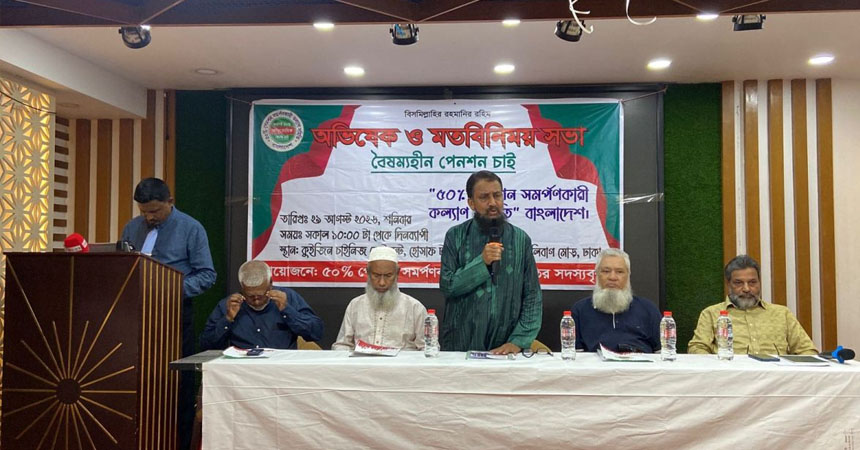
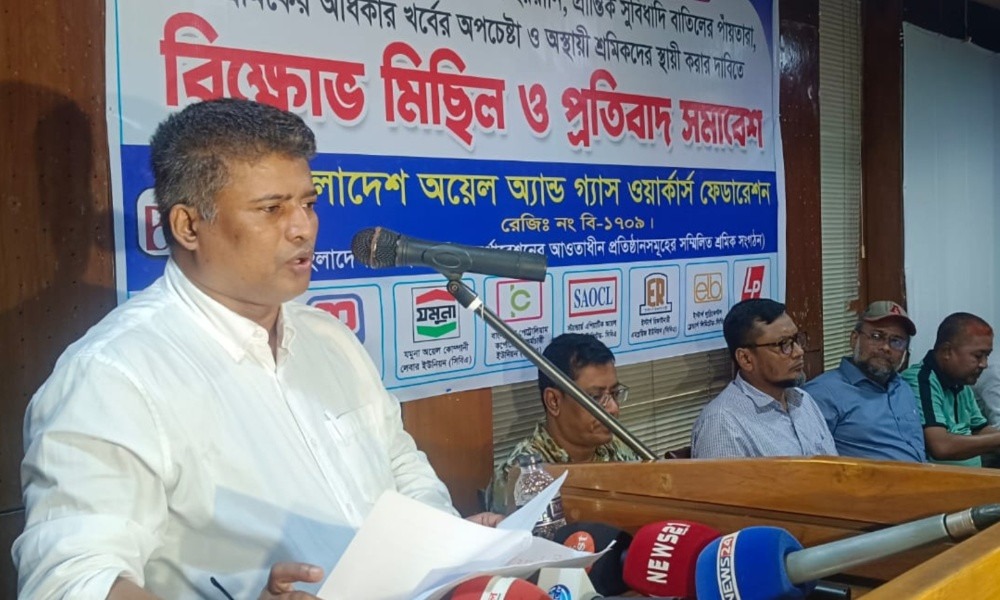
Addressing a rally, Muhammad Yakub affirmed that workers fully align with the Prime Minister's policy of 'Bangladesh First.' He expressed expectations that national interests will remain the top priority when finalizing decisions on private sector refined fuel imports.
He made these remarks during a protest rally and demonstration organized to demand an end to the harassment of energy sector workers and the fulfillment of their pending charter of demands. The demonstration took place on Monday at 12:00 PM in front of 'Jamuna Bhaban,' the head office of Jamuna Oil Company Limited in Agrabad, Chittagong. Workers and employees from various state-owned energy companies participated in the event.
Muhammad Yakub noted that crude oil is already imported by private entities in the country, while discussions regarding refined petroleum imports are currently ongoing. He stressed that any decision in this regard must balance national economic priorities and public interest alongside workers' rights.
"The Honorable Prime Minister has stated—'Bangladesh First.' We echo that sentiment: Bangladesh First. We hope the Prime Minister will decide on private fuel imports by prioritizing national interest and public welfare. We have full faith in his leadership and have no objection to his decision," Yakub stated.
Concerns Over Labor Rights and Sectoral Stability
However, the labor leader raised concerns regarding worker protections, alleging that certain vested interests within the administration are attempting to destabilize the vital energy sector by curbing worker benefits.
He alleged that efforts are underway to cut 22 specific existing benefits and privileges through unwarranted interventions. He further noted that bilateral negotiations to update wage structures have been delayed, while attempts are being made to modify labor regulations in a manner detrimental to workers.
Yakub pointed out that while the central government advocates for safeguarding worker rights, actions on the ground across Bangladesh Petroleum Corporation (BPC) subsidiaries—including Padma, Meghna, Jamuna, SAOCL, and LPG Limited—reflect attempts to reduce existing facilities rather than enhance them.
"Workers want a peaceful operational environment. Our demands are clear: stop harassment, ensure fair rights, and maintain a work environment free from unnecessary interference. We will not allow anyone to create instability in the energy sector. Workers are not asking for extra privileges; they only demand their legitimate rights," he added.
Key Reasons Behind the Protest
Labor leaders outlined several core issues driving the demonstration:
- Delays in Bilateral Agreements: Salary scales and benefits for marketing company employees are traditionally updated every two years via bilateral agreements. However, despite 19 months having passed since the expiration of the previous agreement, companies have failed to execute a new contract.
- Fringe Benefits Policy Draft: On June 17, the Energy and Mineral Resources Division initiated a draft titled 'Fringe Benefits Policy-2026' for BPC subsidiaries, raising fears of cuts across 22 existing benefit categories.
- Proposed Amendments to Labor Law: Workers expressed concern over moves to repeal Sections 209, 210, and 211 (relating to industrial disputes and resolution) under Section 2(62) of the Bangladesh Labour Act 2006 (Amended), warning it would restrict CBA leaders from effectively representing workers.
- Oversight Committee Concerns: An office order issued on July 26 by the Mineral Resources Division formed an eight-member committee headed by BPC's Director (Operations) to monitor Collective Bargaining Agent (CBA) activities in oil marketing companies, creating unease among union representatives.
- Recruitment of Outsourced Staff: Numerous workers have been serving on a 'No Work, No Pay' basis under contractors for extended periods at low wages. However, experienced workers are reportedly being bypassed during new recruitment drives.
The meeting was chaired by Abul Hossain, President of the Jamuna Oil Company Labor Union. Other prominent labor leaders in attendance included Padma Oil Workers and Employees Union President Jasim Uddin, LPG Workers Union President Monir Hossain, BPC Workers Union Joint General Secretary Kamrul Islam, Padma Oil Office Secretary Selim Kabir Chowdhury, and Jamuna Oil Assistant General Secretary Syed Mohammad Mannan.
The Bangladesh Oil and Gas Workers Federation serves as the apex trade union body for workers across the state energy sector, comprising CBA units from the Bangladesh Petroleum Corporation (BPC), Padma Oil Company Limited, Meghna Petroleum Limited, Jamuna Oil Company Limited, Eastern Refinery Limited, Standard Asiatic Oil Company Limited, and LP Gas Limited.