
Bangladesh has experienced this reality before.
In the early 1990s, when countries across South and Southeast Asia were beginning to connect to the emerging global internet network, Bangladesh reportedly had an opportunity to obtain an undersea fibre-optic connection at no cost. The opportunity was not taken, reportedly because of concerns among policymakers that sensitive national information could be transferred abroad.
The decision had consequences. By the time Bangladesh reconsidered the issue, the opportunity was no longer free, and the country had to spend substantial resources to establish connectivity.
The episode carries a lesson that remains relevant today: a decision that appears small or cautious in the present can become a historic cost for the state in the future.
Bangladesh is now facing another such moment.
The geopolitical landscape around the country is changing rapidly. Economic corridors, strategic partnerships, defence cooperation and regional connectivity are increasingly becoming instruments of national power. For Bangladesh, remaining on the sidelines is no longer necessarily the safest option.
The proposed Bangladesh-Myanmar-China connectivity corridor deserves serious consideration.
A viable corridor through Myanmar could significantly improve Bangladesh’s overland connectivity with China and potentially open new routes for trade, investment and regional commerce. It could strengthen Bangladesh’s position between South and Southeast Asia and create opportunities for the country to emerge as a more important regional economic hub.
But connectivity is never merely about roads, railways or trade routes. Infrastructure creates strategic influence. Therefore, any decision must be based on a careful assessment of economic benefits, national security, sovereignty, environmental concerns and Bangladesh’s relationships with its neighbours and major global partners.
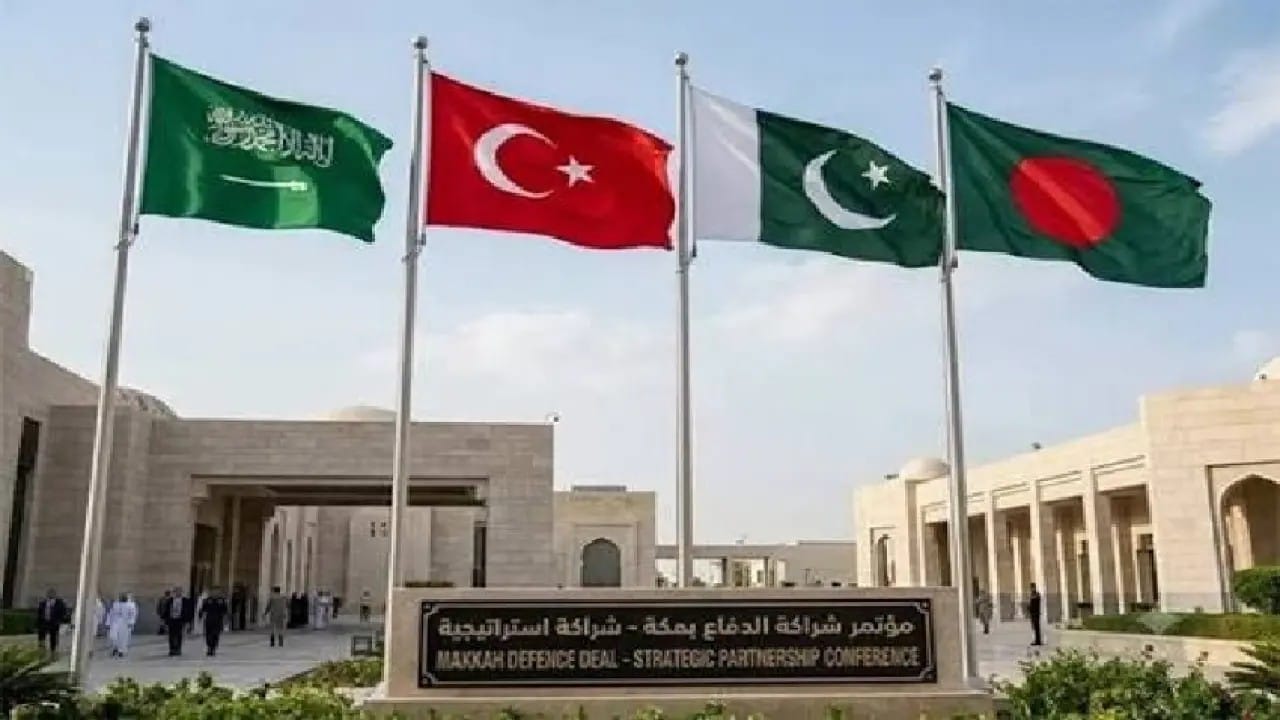
The same strategic calculation applies to the reported invitation for Bangladesh to join the ‘Makkah Joint Defence Pact’ involving Saudi Arabia, Türkiye and Pakistan.
For Bangladesh, this could be more than a defence arrangement. It could represent an opportunity to expand strategic cooperation with three influential countries with significant geopolitical, economic and military capabilities.
Yet it would also mark a departure from Bangladesh’s traditional approach of avoiding formal military blocs. Such a decision could inevitably attract the attention of India, China, the United States and other major partners.
That is precisely why the issue demands neither emotional enthusiasm nor automatic rejection.
India’s concerns cannot be ignored. Nor can Bangladesh’s own security interests be subordinated simply to avoid making another country uncomfortable. A sovereign state must have the freedom to determine its foreign and security policy according to its own national interests.
At the same time, strategic independence does not mean strategic isolation.
Bangladesh needs a foreign policy capable of maintaining strong relations with India while simultaneously expanding meaningful partnerships with China, Saudi Arabia, Türkiye, Pakistan, the United States, Europe and other important actors.
Pakistan’s experience offers an interesting example. Islamabad has managed, despite considerable challenges, to maintain strategic relationships with both Washington and Beijing. Bangladesh should not necessarily copy Pakistan, but it can learn from the principle behind that strategy: international relations do not always require choosing one friend and abandoning another.
The real challenge is diplomatic competence.
If Bangladesh decides to deepen defence cooperation with Saudi Arabia, Türkiye and Pakistan, it must communicate clearly to India and other partners that the move is driven by Bangladesh’s own security and national interests—not by hostility toward any country.
Likewise, if Dhaka pursues greater connectivity with China through Myanmar, it should ensure that the initiative remains commercially and strategically beneficial to Bangladesh rather than becoming an instrument of competition between larger powers.
This is where Prime Minister Tarique Rahman and his government face a historic responsibility.
The government must understand that strategic opportunities rarely remain available forever. A window that exists today may disappear tomorrow. But urgency should never replace careful assessment.
Bangladesh’s economic future is closely tied to exports, foreign investment, remittances and access to international markets. Any major strategic decision must therefore be examined not only through a security lens but also through its potential impact on the economy.
There is another important lesson from the internet episode.
When governments reject new opportunities because of fear, uncertainty or bureaucratic caution, the cost is often paid not by the decision-makers but by future generations.
Bangladesh cannot afford to repeat that mistake.
Nor should it rush into agreements simply because they appear strategically attractive. The country needs transparent evaluation, professional diplomacy, institutional consultation and a clear calculation of risks and benefits.
The objective should be neither alignment with one geopolitical camp nor confrontation with another.
The objective should be ‘Bangladesh first’.
If a strategic partnership strengthens national security, expands economic opportunities, creates employment, improves connectivity and increases Bangladesh’s bargaining power, it deserves serious consideration.
If it threatens sovereignty, destabilises the economy or unnecessarily damages vital international relationships, it should be reconsidered.
This is the balance that Bangladesh needs.
The world is entering a new era of geopolitical competition. Countries that understand this transformation and position themselves wisely will gain influence. Those that hesitate too long may find that strategic space has already been occupied by others.
Bangladesh therefore needs courage—but also caution; ambition—but also calculation; independence—but not isolation.
The decisions being considered today could shape the country for decades.
The question before the government is not simply whether to accept or reject a particular corridor or defence pact.
The larger question is whether Bangladesh is prepared to think strategically about its future.
History gives governments very few opportunities to change the trajectory of a nation.
Bangladesh must be careful not to miss the next one.
The writer is a researcher, media professional, and social worker.