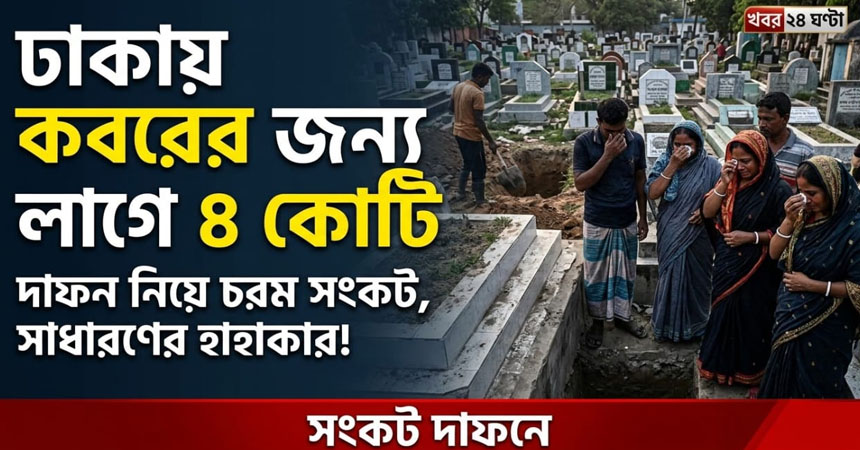
The sharp difference reflects a growing shortage of burial space in the densely populated capital, where demand for land continues to rise while the space available for graveyards remains limited.
At Banani Graveyard, managed by Dhaka North City Corporation, a grave measuring about 20 square feet reportedly costs around Tk3 crore to preserve for 15 years. The cost rises to nearly Tk4.5 crore for 25 years, according to people familiar with the graveyard.
The graveyard has more than 9,000 graves, including both long-term reserved graves and spaces used for regular burials. With little scope to create additional burial space, old graves are reused after their designated period.
For a regular burial, the registration fee is Tk500, excluding other costs such as digging the grave, bamboo and matting. Once the prescribed period ends, the grave can be prepared for reuse.
In reserved graves, however, family members may be allowed to bury other close relatives later. The fee for re-burial at Banani is Tk50,500.
Officials and people familiar with cemetery management say the high cost of long-term preservation is linked mainly to the shortage of land. If large numbers of graves were permanently or long-term reserved, fewer spaces would remain available for new burials.
The situation is not limited to Banani.
Dhaka North City Corporation currently has seven registered public graveyards, including Banani, Mirpur Shaheed Buddhijibi Cemetery, Rayerbazar and graveyards in Uttara sectors 4, 12 and 14, as well as Chamur Khan.
At Mirpur Shaheed Buddhijibi Cemetery, which covers about 63.54 acres, 63,917 bodies were buried between 1983 and June 2024.
The regular burial registration fee there is Tk500. Including prescribed charges for digging, bamboo and matting, the total cost is higher. Long-term preservation, however, costs substantially more, with a 15-year reservation costing Tk20 lakh and a 25-year reservation Tk30 lakh, according to information provided by cemetery authorities.
At Rayerbazar, preserving a grave for 15 years costs Tk10 lakh, while a 25-year reservation costs Tk15 lakh.
The rates are different under Dhaka South City Corporation.
According to the DSCC's current published information, preserving a grave at Azimpur, Jurain or Khilgaon costs Tk5 lakh for 10 years, Tk10 lakh for 15 years, Tk15 lakh for 20 years and Tk20 lakh for 25 years.
The regular burial registration and related charges are separate from the preservation fees. DSCC rules also provide for re-burial in reserved graves for a fee of Tk50,000.
At Azimpur Graveyard, an average of 30 to 35 bodies are reportedly buried each day. As the cemetery's land area remains largely fixed while the number of burials continues to rise, authorities have to reuse ordinary graves after the prescribed period.
This system has also created an emotional dilemma for families. Many want to preserve the graves of their loved ones for generations, but limited space means that such long-term arrangements are available only under specific conditions and at substantial cost.
There are special provisions for freedom fighters. DNCC says graves of recognised freedom fighters can be preserved free of charge for 10 years, subject to the required documentation and approval.
Under cemetery management rules, graves that have been reserved for a fixed period can be treated as ordinary graves after the reservation expires if the family does not renew the arrangement. The space can then be used for another burial.
The land shortage becomes clearer when the cemetery space under the two city corporations is considered together. DNCC's graveyards cover roughly 192 acres, while those under DSCC cover about 59 acres, according to the information cited in the report.
Urban planners say burial grounds need to be considered as part of city planning, alongside housing, roads, hospitals, schools, parks and commercial areas.
Professor Dr Akhter Mahmud, former president of the Bangladesh Institute of Planners, said graveyards are closely connected with people's emotions, social memory and family history. He said the high cost of long-term grave preservation indicates the depth of the burial-space crisis in the capital.
Dhaka's population is continuing to grow, while land is increasingly being used for housing, roads and commercial and public infrastructure. Burial demand is also expected to rise as more people permanently settle in the capital.
The Dhaka Detailed Area Plan has recommendations for keeping smaller graveyards in individual wards, while urban planning provisions also recognise the need for burial space based on population.
The challenge, therefore, is not simply the price of a grave. It is a question of how a rapidly expanding city allocates land for the final resting places of its residents.
For a regular burial, a family may spend only hundreds or a few thousand taka. But preserving the same small piece of land for decades can cost millions, and in Banani, reportedly tens of millions of taka.
In a city where land is becoming increasingly scarce, even a few feet of ground for the dead has become part of the broader struggle over urban space.