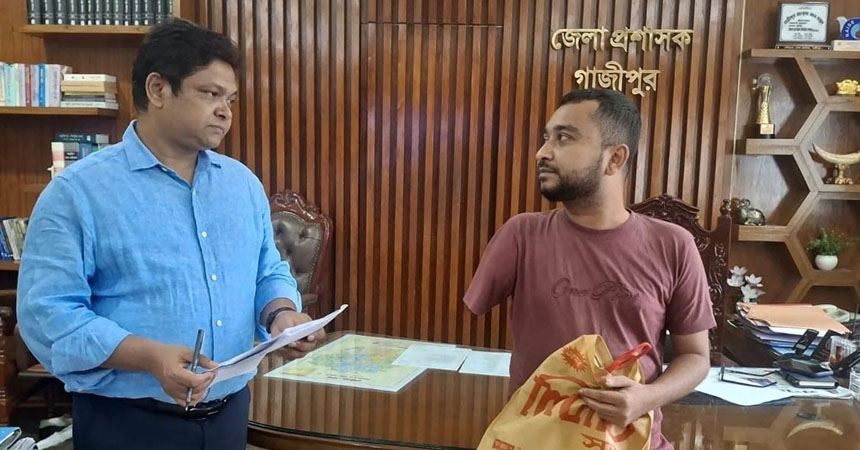
The hearing is held every Wednesday at the deputy commissioner’s office, where people from different parts of the district come with complaints involving medical treatment, financial hardship, land disputes, social assistance, unpaid wages and public services.
During the hearings, the deputy commissioner listens to the applicants and directs relevant officials to take necessary action where possible.
Among those who recently sought assistance was Sania Akter, a garment worker who came seeking help for the treatment of her physically disabled father. The deputy commissioner provided her with financial assistance and assured her of support for treatment at the National Institute of Traumatology and Orthopaedic Rehabilitation, commonly known as the Pangu Hospital, in Dhaka.
Samsunnahar, an elderly woman from Tongi suffering from breast cancer, also received immediate financial assistance for medical treatment.
Another applicant, Halima Akter, said she had been left homeless and faced difficulties involving her in laws and relatives after the death of her husband. After hearing her complaint, the deputy commissioner instructed the assistant commissioner (land) of the Sadar circle to look into the matter and take steps to resolve it.
The public hearings also cover a wide range of administrative and social issues, including payment of compensation for land acquisition, maternity allowances, recovery of unpaid wages from factories, road repairs and demands for establishing new land offices and hospitals at the union level.
Officials from the Social Services Department, Department of Women Affairs, Bangladesh National Disability Development Foundation and relief agencies are also being directed to ensure that eligible people receive government assistance.
According to Nurul Karim Bhuiyan, the administration's objective is to ensure that people from all sections of society can access their rights and receive government services.
“Our only objective is to build a humane Bangladesh where people from all walks of life can receive their rightful services. When I look at these people every day, I feel that helping them is our moral responsibility,” he said.
The weekly hearing has also highlighted the broader role of district administrations in connecting vulnerable citizens with government services and social safety net programmes.
Regular and effective public hearings in other districts could provide people with a direct channel to raise grievances before the local administration. Ensuring that medical assistance, allowances and other government support reach the genuinely needy would also require coordination among different government agencies.
The Gazipur initiative therefore offers a model of direct engagement between the district administration and citizens, with the effectiveness of such a system depending on timely action, proper verification of complaints and follow up by the relevant authorities.