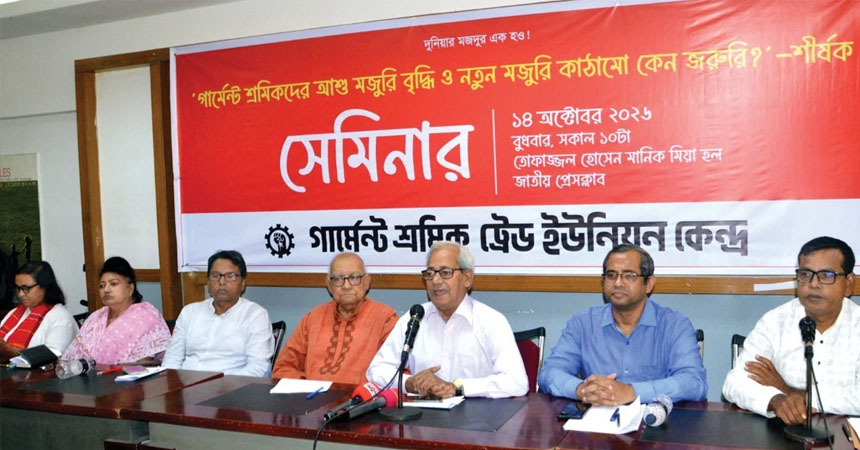
Key discussants at the event included Dr. Khondaker Golam Moazzem, former Research Director at the Centre for Policy Dialogue (CPD) and current President of the Knowledge Hub Institute; Mahmud Hasan Khan, President of the Bangladesh Garment Manufacturers and Exporters Association (BGMEA); Montu Ghosh, President of the Garment Workers Trade Union Centre; Ahsan Habib Bulbul, President of the Garment Sramik Front; Mujahidul Islam Selim, former President of the Communist Party of Bangladesh (CPB); Moshrefa Mishu, President of the Garment Sramik Oikya Forum; and Abdullah Kafi, General Secretary of the CPB.
Dr. Khondaker Golam Moazzem pointed out that the existing minimum wage framework fails to cover basic food, transportation, and medical expenses for garment workers, urging an immediate revision to reflect realistic living costs. He emphasized that wage determination must account for the actual earnings and profits of the ready-made garment (RMG) sector, noting that factory owners have generated substantial wealth to diversify their investments across multiple industries. He criticized the economic disparity where owners earn high profits while workers are denied fair wages, and called for the inclusion of education and entertainment allowances in the new wage structure.
Countering these points, BGMEA President Mahmud Hasan Khan expressed concern over street blockades and labor unrest erupting prior to the formal constitution of a new wage board. He argued that street agitation without data-driven negotiations benefits neither factory owners nor workers. He remarked that since the COVID-19 pandemic, digital wage disbursement showed nearly every worker possesses a mobile phone, with many using smartphones and ATMs, which he suggested indicates an improvement in their standard of living. He further warned that disproportionately hiking garment wages without considering other industrial sectors could trigger a labor market imbalance by drawing workers away from other trades.
In response, Montu Ghosh, President of the Garment Workers Trade Union Centre, maintained that the garment sector stands on the sweat and labor of workers, and neither the government nor factory owners will spontaneously raise wages without organized agitation. Dismissing calls from owners to refrain from protests, he stressed that workers must unite in collective movement to secure fair wages and protect their fundamental rights.